Small Batches. Slow Methods. Enduring Standards.
Stingless Bee Honey in Malaysia: What Makes It Different?
Discover why Malaysian stingless bee honey is different from regular honey—its taste, origin, and the traditional way it has been valued for generations.
STINGLESS BEE HONEY
Ancient Gift Farm
3/19/20262 min read
Stingless Bee Honey in Malaysia: What Makes It Different?
From the Maker’s Table
The first time someone tries stingless bee honey, they pause.
It is not what they expected.
It is not as sweet.
There is a slight tang.
Something sharper, almost alive.
And that moment of hesitation often leads to a question:
What exactly is this honey?
Not All Honey Is Meant to Be the Same
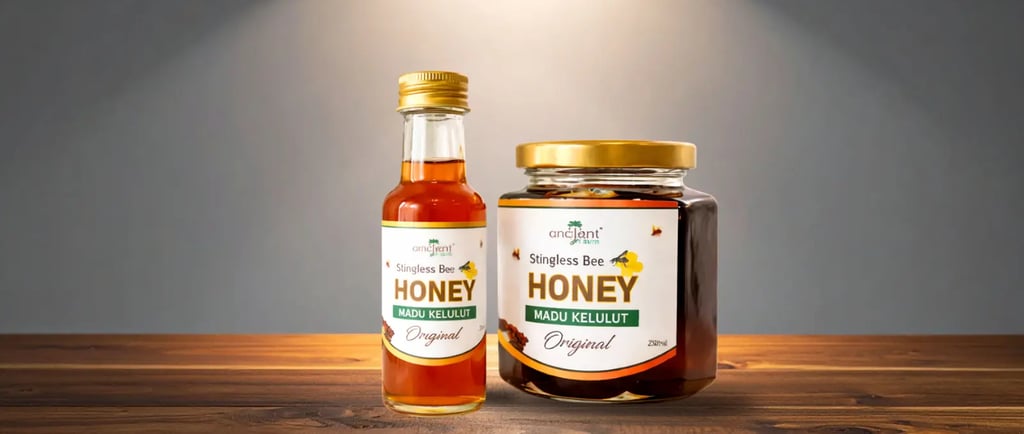
In Malaysia, stingless bee honey often known as madu kelulut or kelulut honey, comes from a completely different species of bees.
Unlike the common honeybee, stingless bees are smaller, quieter, and closer to the forest floor. They collect nectar from small wildflowers, herbs, and native plants found across Malaysia’s tropical landscape.
This alone changes everything.
Because what they produce is not just honey in the usual sense.
It is something shaped by environment, biodiversity, and time.
Why Malaysian Stingless Bee Honey Is Different
Malaysia’s climate plays a quiet but important role.
With year-round rain, dense greenery, and a wide variety of flowering plants, stingless bees here have access to a diverse range of nectar sources.
This creates a honey that is:
tangy
less sweet than conventional honey
more complex in taste
But beyond taste, there is something else.
A sense that it has not been processed, altered, or simplified.
A Taste That Tells a Story
Most people are used to honey being predictable.
Sweet, thick, and familiar.
But stingless bee honey invites a different experience.
It is lighter.
More fluid.
and even slightly sour.
And that difference is not a flaw.
It is a reflection of its origin.
More Than Just a Sweetener
For generations, stingless bee honey was not treated as something casual.
It was kept, not displayed.
Used when needed, not consumed without thought.
In many households, it was taken:
when someone felt unwell
when strength was needed
when the body required balance
It was not about indulgence.
It was about intention.
Not All Stingless Bee Honey Is the Same
Today, as demand grows, not all stingless bee honey available reflects this same level of care.
The way honey is:
harvested
handled
stored
can influence its quality.
Some are overly filtered.
Some are stored too long.
Some lose the very character that made them valuable in the first place.
Which brings us to a quieter question.
How Do You Recognise Good Stingless Bee Honey?
There is no single label that tells you everything.
But there are signs.
A natural aroma.
A balanced tang not overly sharp, not overly sweet.
A consistency that feels alive, not thick or processed.
And perhaps most importantly:
A source you understand.
Returning to the Source
At Ancient Gift Farm, our approach has always been simple.
We do not try to make the honey behave a certain way.
We do not force it to become what people expect.
Instead, we allow it to remain what it already is.
Harvested in small batches.
Handled with care.
Left as close as possible to its natural state.
Because what we bottle should reflect how it was formed.
A Different Way of Choosing
In today’s world, it is easy to choose based on:
price
packaging
brand familiarity
But some ingredients ask for a different kind of attention.
Not just:
“What is this?”
But:
“How was this made?”
Closing Reflection
In Malaysia, stingless bee honey has never been just another product.
It has always been something people kept close.
Something used with purpose.
Something understood.
And perhaps the real question is not whether it is better or different.
But whether we are still choosing it the same way today.
🔗 Explore More
If you are curious to experience stingless bee honey in its natural form:
👉 Explore our Malaysian Stingless Bee Honey
👉 Learn more From Maker’s Table
Ancient Gift Farm
Explore our sleek website template for seamless navigation.
Contact
Newsletter
sales@agiftfarm.com
+6012 610 6274
© 2026. All rights reserved.